Will 2027 be a strong year for hiring in Australia?
Every year since 2002 that the Australian job ads index rose from September to November, hiring grew the following year. It is rising now. Here is where I expect the demand to land.

October is always a tell for hiring strength the following year. We should have a reasonably strong 2027, in specific areas.
Every year since 2002 that the Australian job ads index rose from September to November, hiring grew the following year. Eleven years out of eleven that it happened, because of the correlation between the historical September to November ad figures and the following year: 0.79, which is strong.
The October data is confirmed on 2 November, but this is a rising market. Having watched this for twenty years, I can already see it online, I am receiving briefs and I can hear it in the phones across the recruitment community.
The ANZ Indeed job ads index has risen five months in a row and sits 12.9% above last year, even with the interest rate at 4.6%.
That is BD, client and marketing demand holding through tightening, not demand waiting for relief.
The firms that read the cycle have already moved, either to market or getting ready for it. Private capital and its portfolio companies moved a while ago, and that is accelerating.
Where private capital demand sits
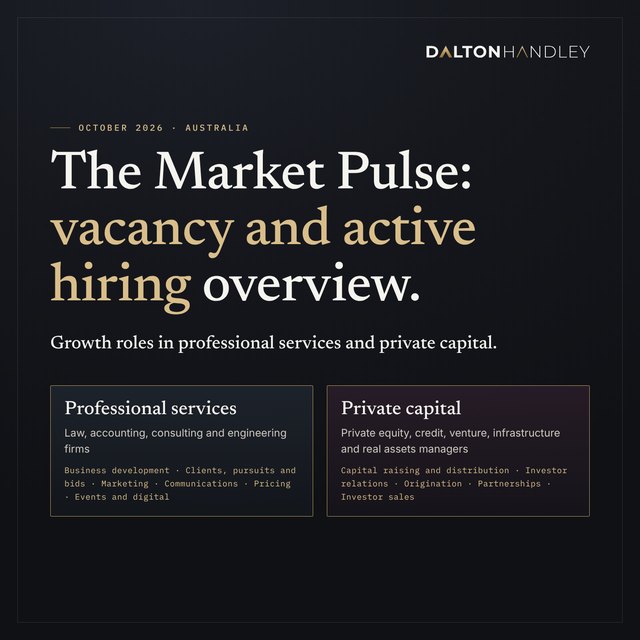
On the fund side the demand is in capital raising and the people who bring money in. Private credit, real estate and private equity managers are hiring into the adviser, private wealth and family office channels, from business development associates through to heads of distribution. Investor relations is moving with it, because a fund that is raising needs the people who keep investors informed and committed between raises. Origination in private credit sits in the same pool: a relationship led role with a long cycle and a small number of valuable counterparties.
The thin layer is senior BDM to head of distribution. The briefs ask for networks, relationships and a record of raising, and that layer will not be filled from junior sales alone. It will be filled from adjacent markets, and professional services BD is the nearest one. A law firm BD manager who has spent years winning panels and running key client programmes already has the discipline. What they learn is the product.
On the portfolio side the demand is different in shape. As private capital moves into accounting, advisory, engineering and consulting, the growth plan is written down and the commercial function is expected to deliver it. The roles that move first are the ones that own revenue: heads of growth and client development, commercial BD leads at manager and senior manager level, and the marketing leaders who can tie a pipeline to the plan rather than report on activity. The firms most likely to be approached are the mid market ones with strong brands, ageing partnerships and no obvious succession, and their BD functions will be asked to show an investor what they deliver before the conversation starts.
Both sides are hiring for proven rather than potential, and both are paying for it above manager level once there is a book or a pipeline to point to.
So my base case for 2027 is moderate and improving hiring, with a commercial twist towards BD. Interestingly, marketing roles in other sectors such as consumer are ramping up at the same time. That shape matters and it is positive.
In professional services I expect the growth to lead in tier one legal and in the accounting, audit and consulting firms building outside the Big 4. The roles that move first are commercially focused BD and client development at mid to senior manager level, in Sydney and Melbourne. That is where demand in law concentrates in a rising market, in the transactional groups, and it is where the best people are already taking calls.
Then watch November
The 28th, and that will paint the picture for 2028 onwards. Some are already moving on what happens next, not waiting for the data to confirm it; they are hiring into it.
Liquidity also fuels hiring. It is rising everywhere. Not in Switzerland, mind you.
The one I keep coming back to is 2007. Ads rose through the last quarter, every signal said strong year ahead, and then the credit markets went. It is the only miss in the series, and it is the reason I watch liquidity as closely as job ads. Watch markets in November. The liquidity spike may well sustain, and transactional activity filters straight into professional services. Their competitors will notice in February. Which signal do you trust most: job ads, deal flow, or your own phone? Watch the NASDAQ through to mid December. If it rockets, there is your answer.
If you want to talk through what this means for your firm, your team or your own next move, message me. Always happy to compare notes.