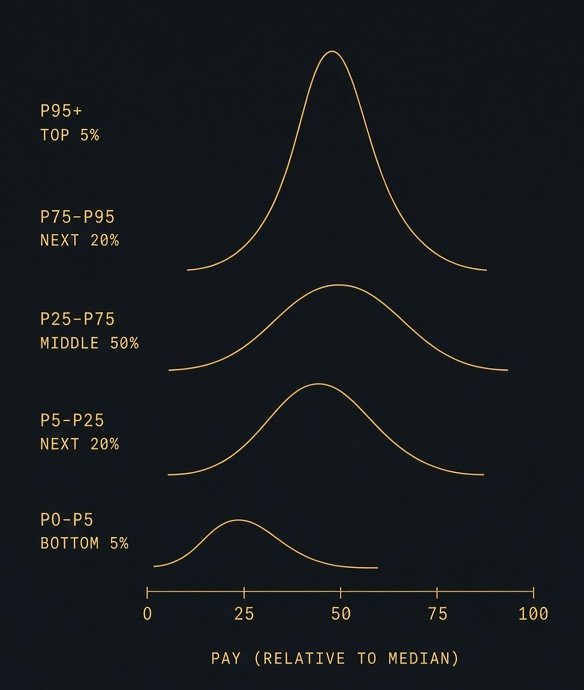
The BD and marketing pyramid may become a diamond
Technology compresses execution. Value shifts to judgement, orchestration and commercial credibility. The firms that moved first already have the longest tenure.

On 11 March 2026, The Economist published “Why corporate lawyers always win”, noting that profits per lawyer at the top 100 US firms had risen 54 per cent since 2019. Australia may not have produced the same headline, but the underlying picture has been strong. Thomson Reuters reported that the average Australian law firm posted 3.6 per cent demand growth, 3.7 per cent worked rate growth and 8.6 per cent fee growth in FY2025, and first half demand in FY2026 is up 4.8 per cent, although the gains look harder won and more uneven beneath the surface.
Having worked across legal BD and marketing for many years, one thing has become increasingly clear: lawyers did not generate those outcomes alone. BD and marketing functions have helped drive sector strategies, client growth, pursuits, market positioning and increasingly the commercial infrastructure around revenue. Yet many firms still treat BD and marketing as one broad support category, grouped into banded salary frameworks moved largely through CPI linked increases and discretionary bonuses. That framing is becoming harder to sustain.
Not everyone in BD and marketing creates the same value. Some roles are operational. Others directly influence growth, partner behaviour, client development and market position. So the answer is not blanket salary increases. It is sharper differentiation around where value sits now and where it is likely to sit next.
This is where technological change starts to matter. Generative AI and automation are compressing large parts of the operational workload across pitches, credentials, research, submissions and reporting. The work is not disappearing, but the manual effort required to deliver it is falling. When productivity shifts that quickly it does not just change how work gets done. It changes how teams are built. As the cost of execution falls, the relative value of commercial judgement rises: people who can connect capability across functions, guide partners, shape sector strategy, lead pursuits and convert market intelligence into revenue.
That reshapes the traditional pyramid. Less weight at the base. More value concentrated through the middle and upper layers. Greater importance attached to judgement, orchestration and commercial credibility. Less pyramid, more diamond, not just in shape but in where firms assign value.
Some firms have been moving quietly in this direction for years. The two firms I have placed the most people into over nearly two decades also have the highest average tenure across their BD and marketing teams, at more than seven years. That sounds counterintuitive, because high placement volumes are usually associated with churn. It reflects something different: the distinction between growth firms and churn firms. Growth firms hire repeatedly because the work expands, people are promoted and new capability is added to a more senior weighted team. Roles are created rather than recycled. Both of those firms moved away from the pyramid some time ago.
The practical question for firms is where to invest: develop and retain the future senior operators already inside the team, or wait and compete for them externally once the market tightens. If more firms reallocate headcount in the same direction, demand will concentrate quickly around commercially minded operators with judgement, credibility and broad market perspective.
It also raises a less comfortable question. If a law firm only hires BD and marketing talent from strings of other law firms, why is that? If the answer is familiarity, partner comfort or safety in tradition, it may say more about internal assumptions than about where the best commercial talent sits. One of the more progressive firms I work with recently met a candidate whose background combined legal experience with time inside a major global consumer business. That breadth was precisely the attraction. Private capital, consolidation and scale may accelerate the shift. They will not create it. The more progressive firms have already started.